
Strategy Without a Budget Is Just a Wish List
Strategic planning season arrives the same way every year.
Someone books a full-day offsite. Someone else orders lunch. A facilitator draws a two-by-two on a whiteboard. By three o'clock you have a document with a vision statement, four strategic pillars, and a list of priorities that looks almost identical to last year's list of priorities, except two things got renamed.
Then the budget process happens in a completely separate room, run by completely different people, following a completely different calendar. And whatever connection existed between the strategy and the money gets lost somewhere between the catering invoice and the year-end audit.
This is not a failure of effort. It is a failure of design. Specifically, a failure to ask one question during the strategy process: how does this actually get paid for?
The answer, when it finally arrives, is usually "we'll figure it out in the budget." Which means the strategy never gets figured out at all. It gets filed under things to do someday.
Half of All Organizations Do This
The data on this is not subtle. A McKinsey survey of over 600 executives found that only about half of companies effectively align their budgets with their corporate strategies. But just 53% say their organizations fully fund the priorities they've identified.
Read that again. Nearly half of all organizations go through an entire strategy process and then decline to fund what came out of it. The document becomes theater. The budget becomes inertia.
Here's what that looks like in practice. A finance director opens the budget template in October and asks: "okay, so what's actually changing this year?" And the honest answer is: not much. Program staff submit numbers based on what they spent last year, plus inflation, plus whatever new thing they're hoping to get approved. The finance team consolidates it. Leadership signs off with minor adjustments.
Research shows that this results in last year's budget just getting a new cover page. Nobody planned it that way. It's just what happens when the people setting strategy and the people controlling the money are in completely different rooms, having completely different conversations, and only meet once a year to hand off a document neither of them wrote together.
"Expand Access" Is Not a Goal
Strategic plans are full of commitments to "expand access," "deepen impact," and "grow partnerships."
These are not goals. They are aspirations with no address.
A goal has a number, a date, and someone's name attached to it. An aspiration has none of those things, which is exactly why it survives the annual planning process unscathed and unchanged, year after year. Only 2% of leaders are confident they will achieve 80 to 100% of their strategic objectives. That's not a mystery. It's the predictable outcome of processes that produce vague commitments and then call them strategy.
The disconnect runs deeper than leadership. Research from Harvard Business Review found that just 5% of employees understand their company's strategy and 71% can't even recognize it in a multiple-choice question. The plan gets approved in September, filed in November, and by January nobody in the building could tell you what it said.
That's not a communication problem. That's a specificity problem.
When strategy is abstract enough to mean anything, it ends up meaning nothing to the people doing the actual work.
Everyone Knows It's Broken
A McKinsey survey found that 70% of executives didn't like their company's strategy process. 70% of board members didn't trust the results. Their most common complaint: strategic plans don't guide actual operations.
What they're describing is the gap between what planning produces and what organizations actually need. They want something they can use. Instead, they get something that looks great in the board packet
According to research from Quantive, 79% of executives are concerned their organization doesn't allocate sufficient resources to implement their strategy. Nearly four in five. Which means the planning process is generating commitments the organization has no real intention of resourcing.
At that point the strategic plan isn't a guide. It's a list of things that were aspirationally important enough to write down but not actually important enough to fund.
Saying Yes to Everything Is the Same as Having No Strategy
Saying yes to everything in a planning process feels inclusive. Feels all encompassing. But it also guarantees nothing gets resourced well enough to work.
When everything is a priority, nothing gets the attention needed to succeed. A strategy document with twelve priorities functions exactly the same as no strategy at all, everything continues as before, just with a much longer appendix.
The part most organizations skip is stopping something.
It feels like failure rather than strategy. But McKinsey is unambiguous: to create a real strategy, actions and policies must remain coherent and aligned, rather than canceled by pursuing too many different initiatives or conflicting purposes.
What Actually Works
Research found that 64% of successful companies build their budgets based on their strategy rather than past behaviors, and those companies substantially outperform the ones that don't.
The mechanism isn't complicated. When the people building the budget are working from the same document as the people setting strategy, the money goes where the goals are. When they work separately, the money goes where it went last year.
What that requires is a roadmap. One document that connects goals to dollars, year by year. What are we doing, what does it cost, and who is paying for it. Simple enough that someone can pick it up in March and know immediately whether the organization is on track or not.
If your strategy and your budget could be written by two completely different teams with no coordination and no one would notice, they probably were. A roadmap is how you fix that, and it is the only planning artifact that actually earns its place on the shelf.
The Roadmap Isn't Complicated
It's just disciplined. Below is the structure applied to a fictional youth employment nonprofit. Three questions per year: what are we doing, what does it cost, who is funding it. And Year 2 doesn't unlock until Year 1 delivers. That conditionality is the whole point. It forces the organization to decide what success actually looks like before they start spending toward the next thing.
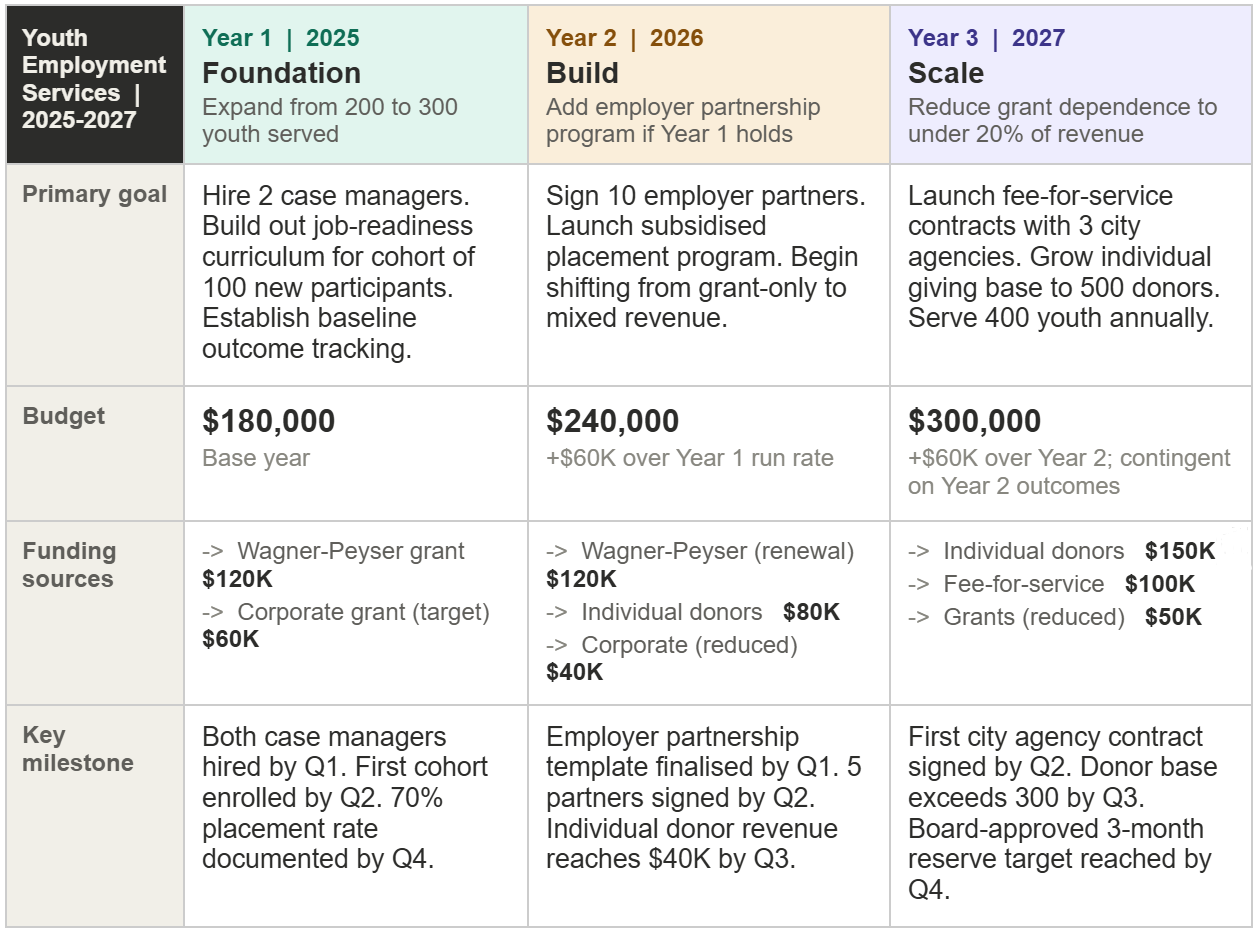
Not in this cycle: Housing wraparound program | Geographic expansion | Capital campaign | International programming | New government contracts before Year 3
Every item on that list is probably something someone in the building genuinely wants to do. Naming what is out of scope is how you protect what is in scope from being quietly diluted over the next eighteen months.
The Gap Doesn't Close on Its Own
It closes when someone decides the plan has to carry the money, and the money has to carry the plan, and someone with no internal gravity helps you see exactly where those two things are drifting apart.
Big Left has no bias in what your strategy says or what your budget protects. No favored program to defend. No board relationship to manage. No stress if the answer differs from the status quo.
What that produces is something most organizations have never actually had in front of them, a clear-eyed read on where your plan and your financial reality stopped talking to each other, and what it's going to take to close that gap.
If what you read here describes something real in your organization, the Strategic Working Session is the right place to start. You bring the situation as it actually exists. We look at it without the politics.
